Coupled ODEs
Kuramoto synchronization, order parameters, and collective onset
When Many Oscillators Talk
The main question in this session is no longer what one trajectory does, but when a whole population of oscillators starts moving coherently.
Ingredients of the Kuramoto Model
State
Each oscillator carries a phase \(\theta_i(t)\) on the unit circle.
Heterogeneity
Each oscillator has a natural frequency \(\omega_i\) drawn from a distribution.
Coupling
All-to-all sinusoidal interaction tries to align phases when \(K > 0\).
\[
\dot \theta_i = \omega_i + \sum_{j=1}^N \frac{K}{N} \sin(\theta_j - \theta_i)
\]
The Macroscopic Observable
\[
r e^{i \Psi} = \frac{1}{N} \sum_{j=1}^N e^{i \theta_j}
\]
Mean-Field Interpretation
\[
\dot \theta_i = \omega_i + K r \sin(\Psi - \theta_i)
\]
Positive feedback
If a small amount of coherence appears, the effective coupling \(K r\) grows and recruits more oscillators.
Critical onset
Synchronization appears when the coupling becomes strong enough relative to the spread of natural frequencies.
From Theory to Bifurcation Diagram
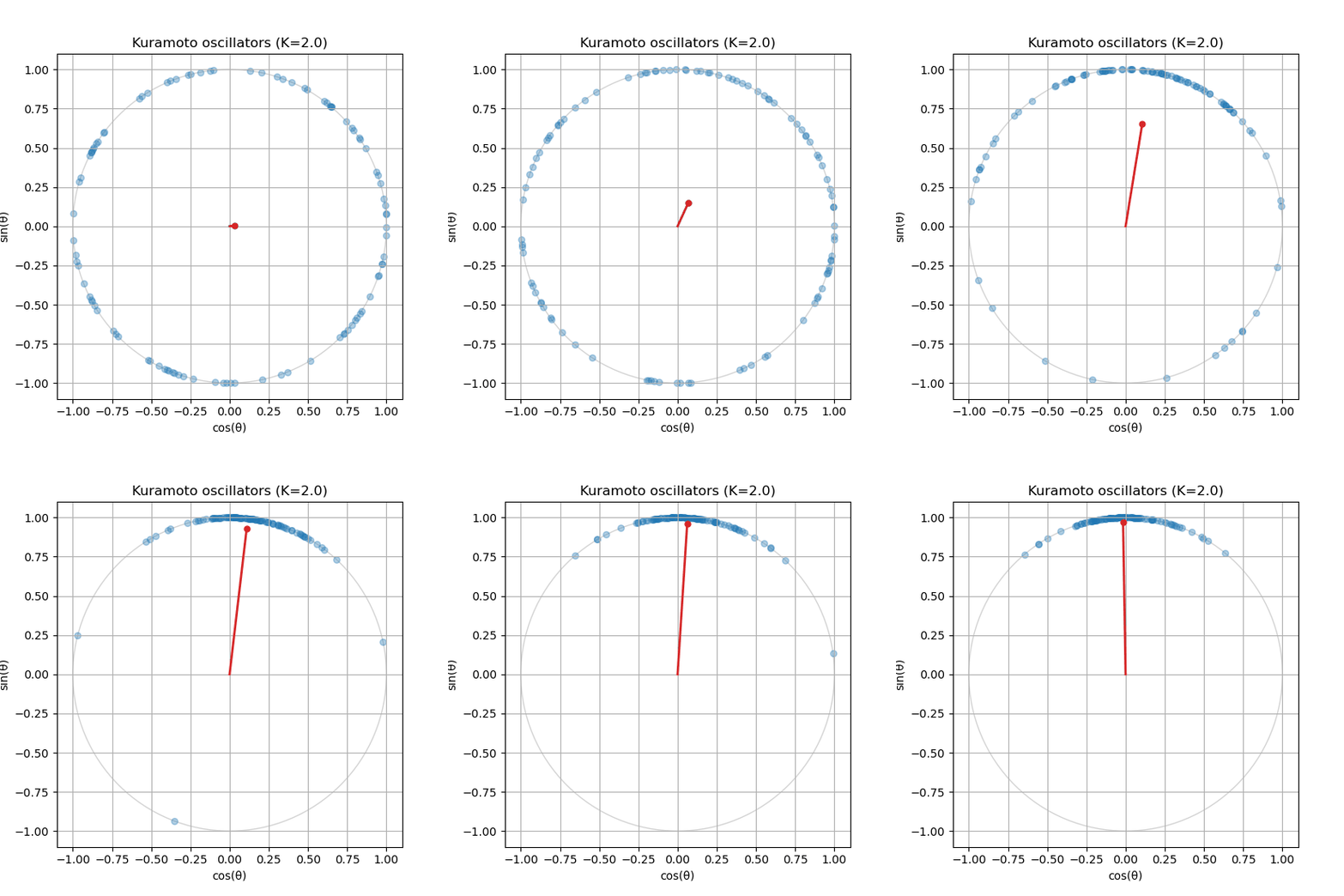
What the Full Simulation Shows
Visual cues to look for
- points clustering on the unit circle,
- growth of the order parameter,
- sensitivity to \(K\), \(N\), and the frequency distribution,
- mismatch between finite-\(N\) simulations and asymptotic theory.
Python stack
solve_ivp() for time integration,matplotlib.animation for the circle dynamics,matplotlib.widgets.Slider for parameter control.
The Assignment Shift
The assignment extends the same synchronization ideas to a more applied system, the Millennium Bridge style crowd-bridge problem. The mathematical structure stays familiar: coupled oscillators, collective response, and parameter-dependent onset.