Case study
Climate risk for Vienna Insurance Group
Climate-adjusted mortality models and a dashboard for life and health insurance, built at IE University with Vienna Insurance Group.
- Public interactive climate-risk dashboard
- First-author working paper, 2026
- VIG board approved a second year of the project
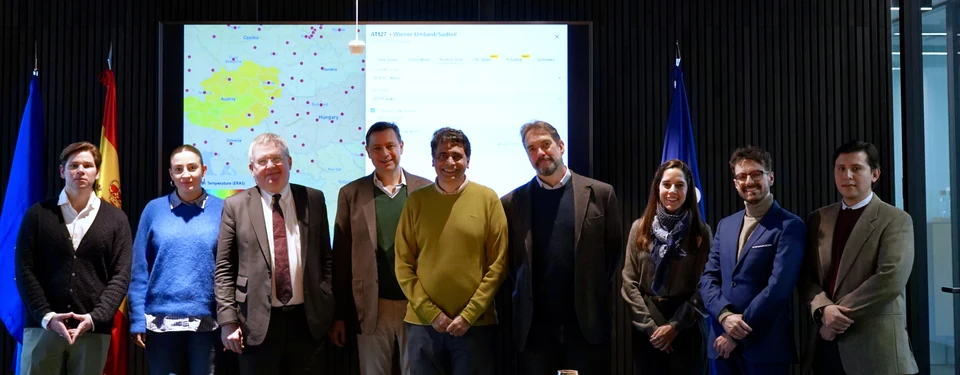
My contribution. I build the climate and mortality models, the code, the dashboard and the reports, and I present the results. In phase 2 I lead the temperature and air quality package.
Project context and partners
Project and partners
-
 Vienna Insurance Group Client. Brings insurance and actuarial expertise.
- IE University Hosts the lab and the Climate Change and Insurance conference.
- Heriot-Watt University Co-author Carmen Boado-Penas, actuarial science.
Who needed the work and why
Vienna Insurance Group (VIG) is a large insurance group in Central and Eastern Europe. Warmer weather affects mortality and health, which changes the assumptions behind life and health products and reserves. VIG and IE University set up the IE Insurance and Tech Lab in July 2025. Its first project is called "Climate Change Effects on Life and Health Insurance".
My role and the collaboration
This is an industry contract run as a research project inside my appointment at IE University. VIG is the client. The IE Insurance and Tech Lab is co-chaired by Ikhlaq Sidhu, Dean of the IE School of Science and Technology, and Klaus Mühleder, Head of Opportunity Management at Vienna Insurance Group. The project is led by David Gómez-Ullate, Vice Dean at IE University. Phase 1 ran in 2025/26 and I was a member of the research team. I developed the dashboard together with Francisco Suárez Pedraza, Research Associate at IE University. Phase 2 runs in 2026/27, after the VIG board approved it in May 2026.
In phase 2, I lead the package on mortality related to temperature and air quality. I develop the models, code, dashboard, reports and presentations as an individual contributor. I coordinate the project meetings with Ikhlaq Sidhu and David Gómez-Ullate, and I present the results to the Lab's steering committee.
What I contributed
- Climate and mortality models that use distributed lag non-linear models and relative risk curves.
- Analysis pipelines that turn climate scenarios into mortality projections by region, age and year.
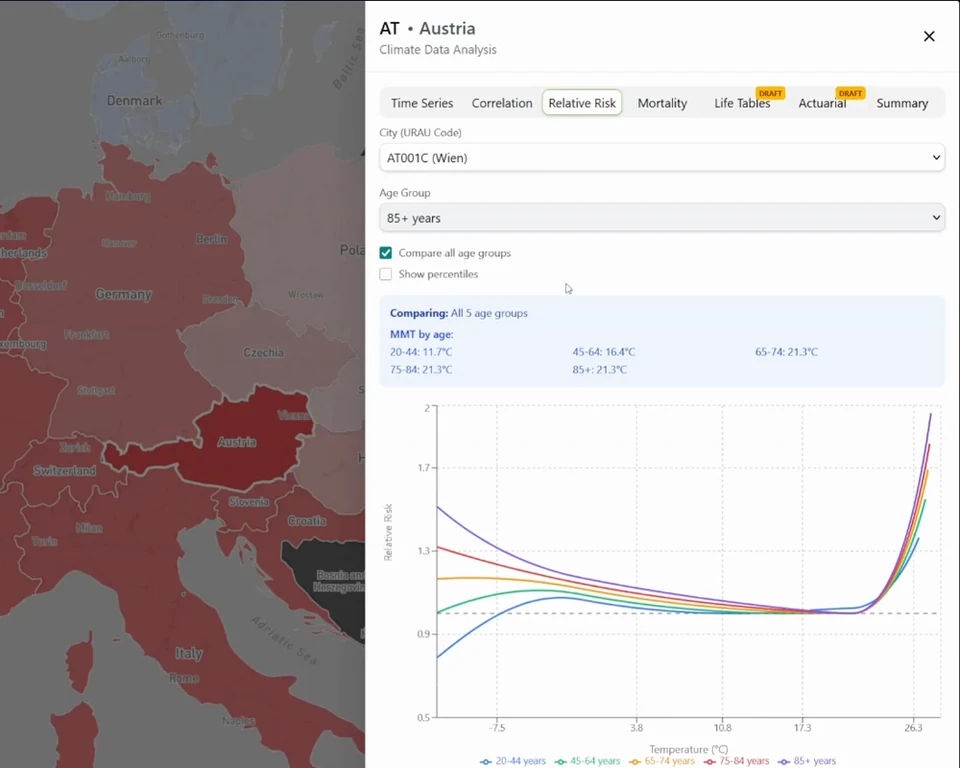
- An interactive dashboard for exploring scenarios. I demonstrated it at the Climate Change and Insurance workshop in Edinburgh in September 2025.
- Presentations to the VIG steering committee and to the VIG board in Vienna in May 2026.
- A member of the organising committee of the Climate Change and Insurance Conference 2026 at IE University.
Main challenge and approach
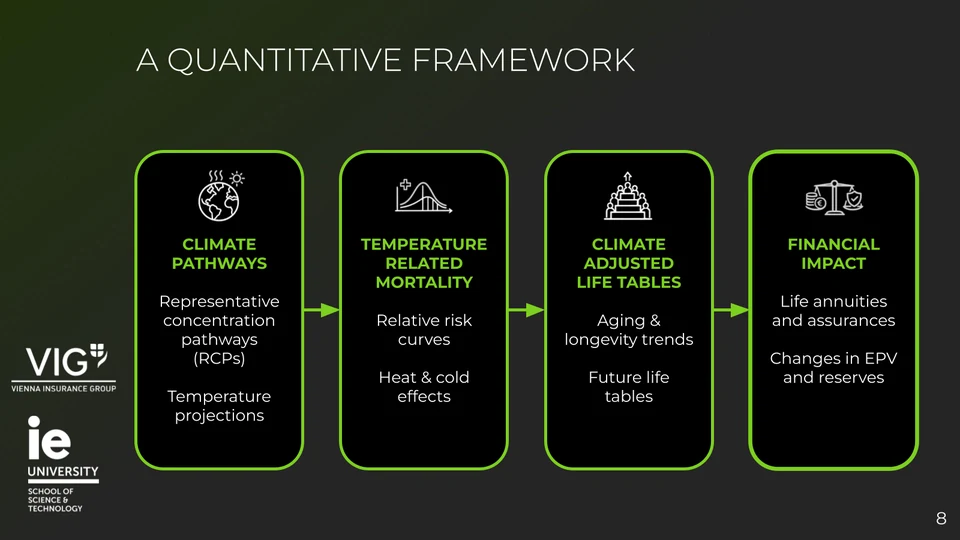
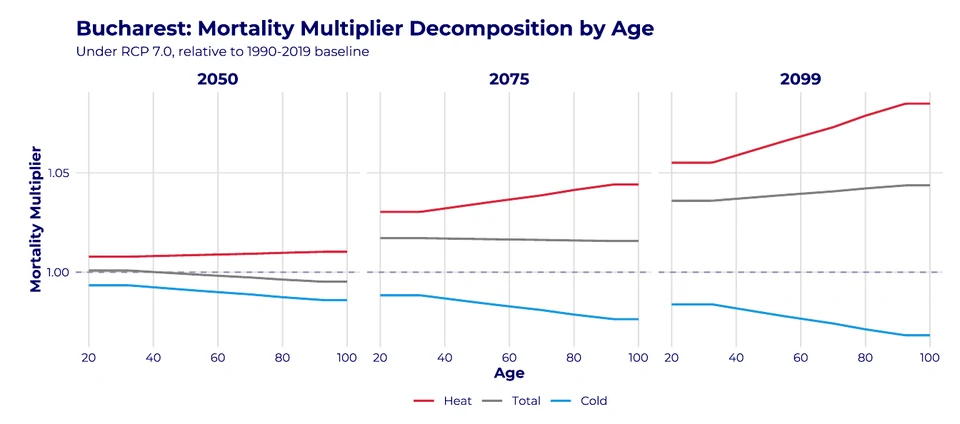
Insurers already have actuarial methods for life tables. The challenge is to add a temperature effect without breaking those methods, and to be clear about how uncertain it is. Our working paper adds the climate effect as a transparent multiplier on baseline mortality, by age and year, under climate scenarios. Uncertainty from the epidemiological estimates, the climate models and adaptation assumptions is carried through a Monte Carlo simulation to annuities, life insurance values and technical provisions.
The dashboard
The public dashboard lets people explore temperature data and projections under moderate and high emissions pathways, air quality layers and the mortality multiplier, by place and week. The preview below is still until you press play.
What was delivered
- An open working paper, "Incorporating Temperature-Dependent Mortality into Projected Life Tables" (IE University, 2026). I am the first author, with F. J. Suárez Pedraza, S. Lloyd, C. Boado-Penas and D. Gómez-Ullate.
- A public interactive dashboard, and results presented to VIG's steering committee several times and to its board once.
Results and limits
- The method is shown on one city, Bucharest, as an illustration. It is not a prediction for a portfolio.
- The paper is a working paper. It has not been peer reviewed.
- The board approved a one-year extension. Phase 2 adds air quality and mental health to the temperature work. Those results do not exist yet.