import random

random.random() # A random number from 0 (included) to 1 (excluded).0.984425325725501Side Project for Extra Credit
Can two games that lose when played separately produce a winning outcome when combined? In this project, you will explore a simple parity-based version of Parrondo’s paradox through simulation.
Main concepts: random numbers, loops, functions as arguments, and parity. You will use a supplied plotting function.

Optional background: Parrondo’s paradox.
Your balance is an integer, and it may become negative. Keep playing for the requested number of rounds even if the balance reaches zero.
Create play_game_A(current_balance):
Use the random module to generate a number:
import random
random.random() # A random number from 0 (included) to 1 (excluded).0.984425325725501The condition random.random() < 0.05 is true with probability 5%. Generate one random number per round.
We will study imports later in the course. For now, run import random once before using the module.
Create play_game_B(current_balance):
Check parity before changing the balance. Unlike Game A, Game B contains no random choice.
Test it with positive, zero, and negative balances. For example, balances of 10, 13, 0, and -1 should become 13, 8, 3, and -6, respectively.
Create simulate_game(game, rounds=1000, initial_capital=10).
game is the function to play, such as play_game_A or play_game_B.rounds is a non-negative integer giving the number of individual plays.initial_capital is the starting balance.Start a list with the initial balance. On each round, call game with the current balance, update the balance, and append it to the list. Return the complete list, which should contain rounds + 1 entries.
You can pass a function as an argument without calling it. For example, simulate_game(play_game_A) passes the function itself; play_game_A(10) calls it immediately.
Run both games and store their histories in a dictionary with labels such as "Game A" and "Game B". Plot the dictionary using the helper below. You do not need to recreate or explain the plotting code.
import matplotlib.pyplot as plt

def plot_results(results):
    """Plot balance histories, including the starting balance at round zero."""
    fig, ax = plt.subplots()
    for label, balances in results.items():
        ax.plot(range(len(balances)), balances, label=label)
    ax.set_xlabel("Rounds played")
    ax.set_ylabel("Balance")
    ax.legend()
    ax.grid(alpha=0.3)
    plt.show()
    plt.close(fig)

# Example histories, supplied only to demonstrate the plotting function.
example_results = {
    "Game A": [10, 9, 8, 7, 6, 5, 4, 3, 2, 1, 0],
    "Game B": [10, 13, 8, 11, 6, 9, 4, 7, 2, 5, 0]
}
plot_results(example_results)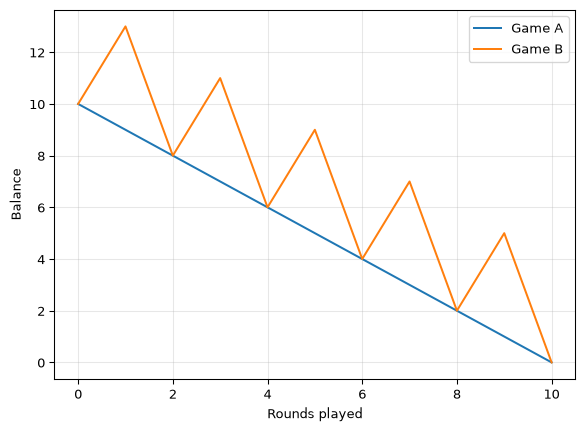
Explain why each game loses over time when played on its own. For Game A, consider the average change per round. For Game B, consider two consecutive rounds.
Create simulate_alternating_games(game_A, game_B, rounds=1000, initial_capital=10, start_with="B").
Alternate between the two functions, starting with the game named by start_with, which may be "A" or "B". Here, rounds counts individual plays, not pairs: four rounds starting with B means B, A, B, A.
As before, return the initial balance followed by the balance after every round.
First use the default starting balance of 10 and start with B. Add this history to your results dictionary and plot all three strategies together.
Then repeat the alternating simulation starting with A. Add this fourth history and plot again.
Use your results to answer these questions:
Trace the first four plays by hand to support your explanation. You do not need advanced probability calculations.
random.seed(42) once before an experiment if you want to reproduce the same sequence of random draws. Do not reset the seed inside either game function.Upload your completed notebook to the Side Projects section on Blackboard before the final exam.
Include tests of the game rules, plots of the four strategies, and your explanation of the role of parity. Follow the notebook and AI-use guidance on the Side Projects page.