The Social Force Model
Module 2: Synchronization and Collective Behaviour
(helbing1995social?) model pedestrians as if they were subject to “social forces”. These forces are not physical. They measure the motivation of a pedestrian to change velocity in response to a goal, to other people and to walls. Unlike the Vicsek and Couzin models, this is a continuous-time model with acceleration, so speeds can change.
Equation of motion
Pedestrian \(\alpha\) wants to walk in the direction \(\mathbf{e}_\alpha\) of its next target at desired speed \(v^0_\alpha\). Deviations from the desired velocity relax on a time scale \(\tau_\alpha\):
\[ \mathbf{F}^0_\alpha = \frac{1}{\tau_\alpha}\left(v^0_\alpha \mathbf{e}_\alpha - \mathbf{v}_\alpha\right). \tag{1}\]
The total social force adds repulsion from other pedestrians \(\beta\), repulsion from borders \(B\) and optional attractions \(i\) (helbing1995social?):
\[ \frac{d\mathbf{w}_\alpha}{dt} = \mathbf{F}^0_\alpha + \sum_\beta \mathbf{F}_{\alpha\beta} + \sum_B \mathbf{F}_{\alpha B} + \sum_i \mathbf{F}_{\alpha i} + \text{fluctuations}, \tag{2}\]
where \(\mathbf{w}_\alpha\) is the preferred velocity. The actual velocity equals \(\mathbf{w}_\alpha\), capped at a maximum speed \(v^{\max}_\alpha\).
Repulsion
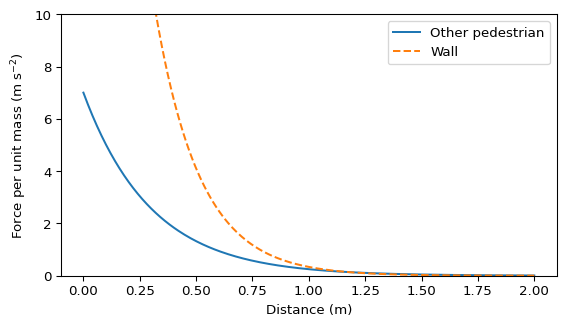
The repulsion from pedestrian \(\beta\) is the gradient of a potential, \(\mathbf{f}_{\alpha\beta} = -\nabla_{\mathbf{r}_{\alpha\beta}} V_{\alpha\beta}[b(\mathbf{r}_{\alpha\beta})]\), with \(\mathbf{r}_{\alpha\beta} = \mathbf{r}_\alpha - \mathbf{r}_\beta\). The equipotential lines are ellipses stretched in the walking direction of \(\beta\), because \(\beta\) needs room for its next step:
\[ 2b = \sqrt{\left(|\mathbf{r}_{\alpha\beta}| + |\mathbf{r}_{\alpha\beta} - v_\beta \Delta t\, \mathbf{e}_\beta|\right)^2 - (v_\beta \Delta t)^2}. \tag{3}\]
Forces from behind count less. A situation outside the angle of sight \(2\varphi\) is weighted by a factor \(c\) with \(0 < c < 1\).
In their simulations (helbing1995social?) used \(V_{\alpha\beta}(b) = V^0 e^{-b/\sigma}\) and \(U_{\alpha B}(d) = U^0 e^{-d/R}\) with \(V^0 = 2.1\ \text{m}^2\text{s}^{-2}\), \(\sigma = 0.3\) m, \(U^0 = 10\ \text{m}^2\text{s}^{-2}\), \(R = 0.2\) m, \(\Delta t = 2\) s, \(\tau_\alpha = 0.5\) s, \(2\varphi = 200^\circ\) and \(c = 0.5\). Desired speeds were normal with mean \(1.34\) m/s and standard deviation \(0.26\) m/s.
Collective effects
With only these local rules, simulations reproduced two effects seen in real crowds (helbing1995social?):
- Lane formation in counterflowing crowds: people walking in the same direction form lanes.
- Oscillations at bottlenecks: at a narrow door, the passing direction switches back and forth between the two groups.
Exercise
A pedestrian walks at \(1.0\) m/s and wants \(1.34\) m/s. What acceleration does Equation 1 give with \(\tau = 0.5\) s? How long does it take to close most of the gap?
Solution
The acceleration is \((1.34 - 1.0)/0.5 = 0.68\ \text{m s}^{-2}\). Without other forces, the gap decays like \(e^{-t/\tau}\), so after about \(3\tau = 1.5\) s only \(5\%\) of it is left.
Exercise
Name one difference between the social force model and the Vicsek model, in the rules and in the question each model answers.
Solution
In the rules: Vicsek particles have fixed speed and only turn; social force pedestrians accelerate and decelerate, and each has its own goal. In the question: Vicsek asks when a group with no goal starts moving together. The social force model asks how people with goals share space, which is why (helbing1995social?) propose it as a tool for planning pedestrian areas.