The Nagel-Schreckenberg Model
Module 6: Explorables and Discrete Models
Reading
- Compulsory: Nagel and Schreckenberg (1992).
- Recommended: (boccara2010modeling?), Chapter 6.
Nagel and Schreckenberg proposed a cellular automaton for single-lane freeway traffic (Nagel and Schreckenberg 1992). The road is a ring of \(L\) cells. Each cell is empty or holds one car. Each car \(n\) has a position \(x_n\) and an integer speed \(v_n \in \{0, 1, \ldots, v_{\max}\}\), measured in cells per time step. The model is agent-based: every car carries its own state and reacts to the car in front.
From cellular automata to agents
In an elementary cellular automaton every cell follows the same binary rule. The traffic model keeps discrete time and a one-dimensional road, but enriches the state (Nagel and Schreckenberg 1992; Wilensky and Rand 2015):
- Occupied cells correspond to cars.
- Each car stores a speed.
- The update depends on the gap ahead and on a random slowdown.
The update is still local. It is more expressive, because agents now carry internal state.
Why call this agent-based if the road is still a grid? Because each occupied cell corresponds to an individual car with its own speed. You write the update from the point of view of each car and its local environment, not as an equation for a global density field.
The road is periodic: the first and last cells are neighbours. This removes boundary effects and makes the congestion dynamics easier to interpret. The page Boundary Conditions shows what an open edge does to Rule 184.
The four rules
Let \(d_n\) be the number of empty cells between car \(n\) and the car ahead. At every time step, all cars apply the following rules in this order, in parallel (Nagel and Schreckenberg 1992):
- Acceleration. \(v_n \leftarrow \min(v_n + 1,\ v_{\max})\).
- Braking. \(v_n \leftarrow \min(v_n,\ d_n)\).
- Randomization. With probability \(p\), \(v_n \leftarrow \max(v_n - 1,\ 0)\).
- Motion. \(x_n \leftarrow x_n + v_n\).
Rule 2 guarantees that cars never collide. Cars never overtake, so their order on the ring never changes. The number of cars is conserved on the ring, and the density is \(\rho = N/L\).
The role of the randomization step
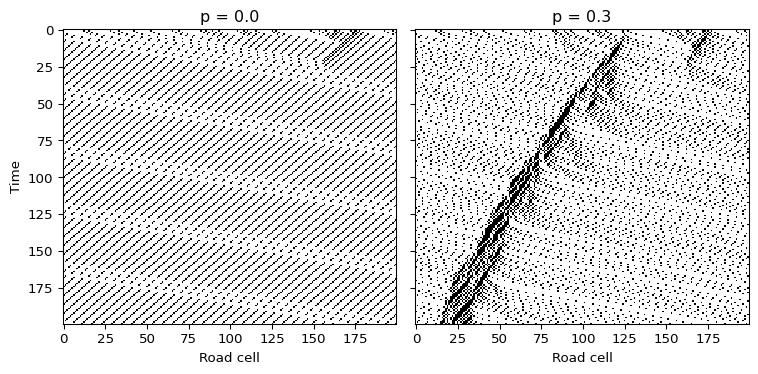
Without rule 3 (\(p = 0\)) the model is deterministic. From a random start it reaches a stationary state with flow
\[ q(\rho) = \min\big(\rho\, v_{\max},\ 1 - \rho\big), \]
so every car moves at \(v_{\max}\) for \(\rho < 1/(v_{\max}+1)\) and jams only appear above that density (chowdhury2000statistical?).
With \(p > 0\) three things change (Nagel and Schreckenberg 1992; chowdhury2000statistical?):
- drivers fluctuate in speed, even on an empty road;
- a car that brakes randomly forces the car behind to brake, which can start a jam in free traffic, with no external cause;
- jams move backwards, against the direction of traffic.
With \(v_{\max} = 1\) and \(p = 0\) the model reduces to the elementary Rule 184 (chowdhury2000statistical?).
Scales
In the original interpretation one cell corresponds to 7.5 m, the space a car occupies in a jam, and one time step to about 1 s. Then \(v_{\max} = 5\) corresponds to \(5 \times 7.5\) m/s \(= 135\) km/h (Nagel and Schreckenberg 1992).
Exercise
Why must the braking rule come before the randomization rule? What could go wrong if you apply randomization first and braking second?
Solution
If randomization comes first, a car whose speed is limited by the gap (\(d_n < v_n - 1\)) brakes to \(d_n\) anyway, so the random slowdown has no effect on it. Fluctuations would then only act on cars with enough free road ahead, and cars in dense traffic would move deterministically. In the original order the random slowdown acts after braking, on every car, including cars that follow closely. This is what lets one random slowdown propagate backwards as a jam. Test it: swap the two rules in your code and compare the space-time diagrams.
Next
Nagel, Kai, and Michael Schreckenberg. 1992. “A Cellular Automaton Model for Freeway Traffic.” Journal de Physique I 2 (12): 2221–29. https://doi.org/10.1051/jp1:1992277.
Wilensky, Uri, and William Rand. 2015. An Introduction to Agent-Based Modeling: Modeling Natural, Social, and Engineered Complex Systems with NetLogo. MIT Press.