The Spruce Budworm Model
Module 1: Low-Dimensional Dynamics
Reading
- Compulsory: Strogatz (2024), Section 3.7, “Insect outbreak”.
- Recommended: (ludwig1978qualitative?).
The spruce budworm is a forest insect whose outbreaks defoliate balsam fir forests. Ludwig, Jones and Holling modelled the budworm and forest system of New Brunswick, Canada, with the budworm as a fast variable and the forest as a slow one (ludwig1978qualitative?). On this page you keep the forest fixed and study the budworm alone, as in Strogatz (2024), Section 3.7.
The dimensional model
Let \(N(t)\) be the budworm density. With the forest held fixed,
\[ \frac{dN}{dt} = RN\left(1 - \frac{N}{K}\right) - \frac{BN^2}{A^2 + N^2}. \tag{1}\]
- \(RN(1 - N/K)\) is logistic growth with rate \(R\) and carrying capacity \(K\). The carrying capacity depends on the amount of foliage.
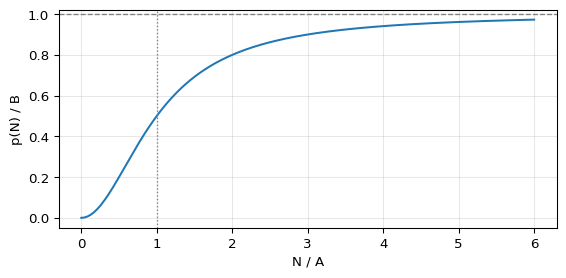
- \(p(N) = BN^2/(A^2 + N^2)\) is predation, mainly by birds. It saturates at the maximum rate \(B\) when budworms are abundant. It vanishes like \(N^2\) at low density, because birds switch to other food when budworms are rare. This is a Holling type III functional response (ludwig1978qualitative?).
- \(A\) sets the density at which predation starts to saturate: \(p(A) = B/2\).
Ludwig et al. chose these forms because they need few parameters, and they state that the conclusions depend only on the qualitative shape of the terms (ludwig1978qualitative?).
Removing the units
Equation 1 has four parameters \(R, K, A, B\). Rescale the density by \(A\) and time by \(A/B\):
\[ x = \frac{N}{A}, \qquad \tau = \frac{B}{A}t . \]
Since \(dN/dt = B\, dx/d\tau\), dividing Equation 1 by \(B\) gives
\[ \frac{dx}{d\tau} = r x\left(1 - \frac{x}{k}\right) - \frac{x^2}{1 + x^2}, \qquad r = \frac{RA}{B}, \quad k = \frac{K}{A}. \tag{2}\]
Only two dimensionless groups remain (Strogatz 2024, sec. 3.7). Ludwig et al. obtain the same groups under the names \(R\) and \(Q\) (ludwig1978qualitative?, eqn 8).
- \(r\) compares the budworm growth rate with the maximum predation rate.
- \(k\) is the carrying capacity measured in units of the predation scale \(A\).
The rest of the module uses Equation 2. Parameter values quoted as \(r\) and \(k\) are always the dimensionless ones.
Exercise
Check that \(r\) and \(k\) are dimensionless. Assume \(N\) is measured in larvae per acre and \(t\) in years.
Solution
\(R\) has units 1/year. \(A\) has units larvae/acre. \(B\) is a rate of larvae eaten, so it has units larvae/acre/year. Then \(RA/B\) has units (1/year)(larvae/acre)/(larvae/acre/year), which cancel. \(K/A\) is a ratio of two densities.
Next
Strogatz, Steven H. 2024. Nonlinear Dynamics and Chaos: With Applications to Physics, Biology, Chemistry, and Engineering. Chapman; Hall/CRC.