Predicted drift period for Omega = 1.3: 28.10Module 2: Synchronization and Collective Behaviour
A single firefly can lock its flashing to a periodic light. The model below, from Strogatz (2024, sec. 4.5), is based on (ermentrout1984beyond?). It is the smallest model of synchronization: one oscillator driven by one rhythm.
Let \(\Theta(t)\) be the phase of the stimulus and \(\theta(t)\) the phase of the firefly. A flash happens when a phase passes through \(0\). The stimulus runs at constant frequency \(\Omega\). The firefly has natural frequency \(\omega\) and is pulled toward the stimulus with strength \(A > 0\):
\[ \dot\Theta = \Omega, \qquad \dot\theta = \omega + A\sin(\Theta - \theta). \tag{1}\]
If the stimulus is ahead (\(0 < \Theta - \theta < \pi\)), the firefly speeds up. If it is behind, the firefly slows down.
The quantity you care about is the phase difference \(\phi = \Theta - \theta\). It obeys
\[ \dot\phi = \Omega - \omega - A\sin\phi. \tag{2}\]
With the dimensionless time \(\tau = At\) and detuning \(\mu = (\Omega - \omega)/A\), this becomes
\[ \phi' = \mu - \sin\phi, \tag{3}\]
which is the nonuniform oscillator from Flows on the Circle.
In the original variables the firefly entrains when
\[ \omega - A \le \Omega \le \omega + A. \tag{4}\]
Outside this range, the time for \(\phi\) to grow by \(2\pi\) is
\[ T_{\text{drift}} = \frac{2\pi}{\sqrt{(\omega - \Omega)^2 - A^2}}. \tag{5}\]
Both predictions can be tested with a flashing light, because \(\omega\) and the width of the locking range are measurable (Strogatz 2024, sec. 4.5). Real fireflies differ between species. Some can even shift their own natural frequency, which needs an extra adaptation variable (ermentrout1991adaptive?).
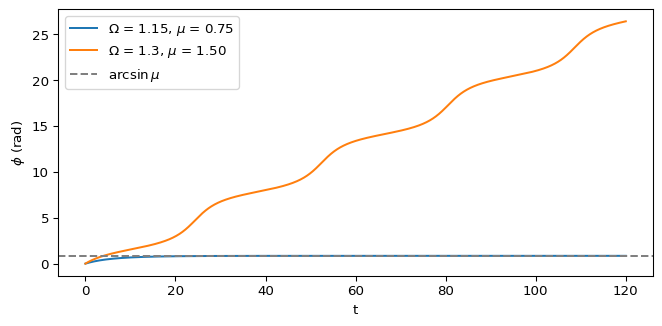
Predicted drift period for Omega = 1.3: 28.10Use Figure 1 and the printed value. Measure the drift period in the plot for \(\Omega = 1.3\) and compare it with Equation 5.
With \(\omega = 1\), \(\Omega = 1.3\) and \(A = 0.2\), Equation 5 gives \(T_{\text{drift}} = 2\pi/\sqrt{0.09 - 0.04} = 2\pi/\sqrt{0.05} \approx 28.1\). In the plot \(\phi\) climbs by about \(2\pi \approx 6.28\) every 28 time units, with slow stretches where \(\phi\) is near \(\pi/2\), the bottleneck.
A firefly has a natural period of \(0.9\) s and entrains to stimulus periods between \(0.78\) s and \(1.06\) s. Estimate \(A\).
Convert periods to angular frequencies with \(\Omega = 2\pi/T\). The extremes of the locking range are \(\Omega_{\max} = 2\pi/0.78 \approx 8.06\) and \(\Omega_{\min} = 2\pi/1.06 \approx 5.93\) rad/s. By Equation 4, \(\Omega_{\max} - \Omega_{\min} = 2A\), so \(A \approx 1.06\) rad/s. The midpoint, \(6.99\) rad/s, is close to \(\omega = 2\pi/0.9 \approx 6.98\) rad/s, which is a consistency check. (These numbers are illustrative, chosen for the exercise.)
Here the stimulus is fixed and does not respond to the firefly. In a swarm every firefly is both a stimulus and a responder. The Kuramoto model in Session 11 treats that case.