Critical Coupling
Module 2: Synchronization and Collective Behaviour
This page summarizes Kuramoto’s self-consistency argument for the limit \(N \to \infty\), following Strogatz (2000, sec. 4). Work in the rotating frame, so \(g\) is symmetric about \(0\).
Steady states with constant \(r\)
Look for steady solutions in which \(r\) and \(\psi\) are constant. In the rotating frame, with \(g\) symmetric, you can choose the origin of phases so that \(\psi = 0\) (Strogatz 2000). Then the mean-field equation reads
\[ \dot\theta_i = \omega_i - K r \sin\theta_i. \tag{1}\]
Each oscillator is a nonuniform oscillator (Flows on the Circle) with \(a = Kr\). The population splits in two groups:
- Locked oscillators, \(|\omega_i| \le Kr\), sit at a stable fixed point with \(\sin\theta_i = \omega_i/(Kr)\) and \(|\theta_i| \le \pi/2\).
- Drifting oscillators, \(|\omega_i| > Kr\), circulate around the circle. Their stationary distribution is symmetric under \(\theta \to \theta + \pi\) together with \(\omega \to -\omega\), so they add nothing to \(r\) (Strogatz 2000).
Self-consistency
Only the locked oscillators contribute to \(r\). Using \(\omega = Kr\sin\theta\) to change variables,
\[ r = K r \int_{-\pi/2}^{\pi/2} \cos^2\theta \; g(Kr\sin\theta)\, d\theta. \tag{2}\]
\(r = 0\) always solves Equation 2: this is the incoherent state. A partially locked state with \(r > 0\) must satisfy
\[ 1 = K \int_{-\pi/2}^{\pi/2} \cos^2\theta \; g(Kr\sin\theta)\, d\theta. \tag{3}\]
Letting \(r \to 0^+\) and using \(\int_{-\pi/2}^{\pi/2}\cos^2\theta\,d\theta = \pi/2\) gives the threshold where this branch starts:
\[ K_c = \frac{2}{\pi g(0)}. \tag{4}\]
This is Kuramoto’s formula for the critical coupling (Kuramoto 2003; Strogatz 2000).
Two cases you will use
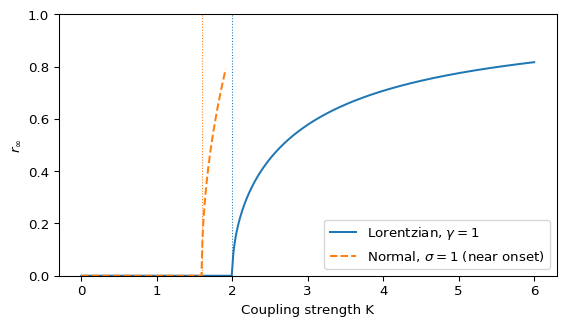
Lorentzian frequencies. For \(g(\omega) = \gamma / [\pi(\gamma^2 + \omega^2)]\), Equation 4 gives \(K_c = 2\gamma\) and Equation 3 can be solved exactly:
\[ r = \sqrt{1 - \frac{K_c}{K}}, \qquad K \ge K_c. \tag{5}\]
Normal frequencies. For a normal density with standard deviation \(\sigma\), \(K_c = 2\sqrt{2\pi}\,\sigma/\pi = \sqrt{8/\pi}\,\sigma \approx 1.596\,\sigma\). There is no closed form for \(r(K)\), so you solve Equation 3 numerically.
Square-root onset
For any smooth \(g\) with \(g''(0) < 0\), expanding Equation 3 for small \(r\) gives
\[ r \approx \sqrt{\frac{16}{\pi K_c^3}}\sqrt{\frac{\mu}{-g''(0)}}, \qquad \mu = \frac{K - K_c}{K_c}, \tag{6}\]
so \(r\) grows like \(\sqrt{K - K_c}\) just above threshold (Strogatz 2000). The transition from incoherence to partial locking is continuous. The same square-root law appears at a supercritical pitchfork bifurcation.
What the argument does not show
Kuramoto’s argument finds the steady states. It does not prove which of them are stable, nor that the population approaches them. These questions were settled only by much later work, which Strogatz (2000) reviews. Finite \(N\) adds fluctuations of order \(N^{-1/2}\) on top of these curves (Finite-Size Effects).
Exercise
Check that Equation 6 agrees with the Lorentzian result Equation 5 near \(K_c\).
Solution
For \(\gamma = 1\), \(g(0) = 1/\pi\), \(K_c = 2\) and \(g''(0) = -2/\pi\). Then Equation 6 gives \(r \approx \sqrt{16/(8\pi)}\,\sqrt{\mu\pi/2} = \sqrt{\mu}\). The exact result is \(r = \sqrt{(K - K_c)/K} = \sqrt{\mu K_c/K}\), which tends to \(\sqrt{\mu}\) as \(K \to K_c\).
Exercise
Your frequencies are normal with \(\sigma = 0.5\). What is \(K_c\)? What happens to \(K_c\) if you double the spread of frequencies?
Solution
\(K_c = \sqrt{8/\pi}\times 0.5 \approx 0.80\). Since \(g(0) \propto 1/\sigma\), \(K_c\) is proportional to \(\sigma\). Doubling the spread doubles \(K_c\): a more diverse population needs stronger coupling to synchronize.
References
Kuramoto, Yoshiki. 2003. Chemical Oscillations, Waves, and Turbulence. Dover Publications.
Strogatz, Steven H. 2000. “From Kuramoto to Crawford: Exploring the Onset of Synchronization in Populations of Coupled Oscillators.” Physica D: Nonlinear Phenomena 143: 1–20.