Bistability
Module 1: Low-Dimensional Dynamics
For some values of \(r\) and \(k\) the budworm model has two stable fixed points separated by an unstable one. The system is then bistable: the long-run state depends on where you start (Strogatz 2024, sec. 3.7).
Two stable states
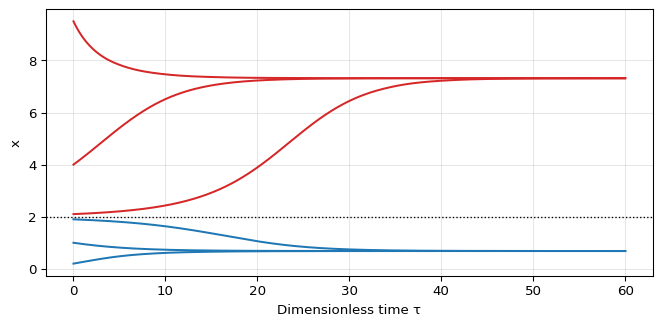
With \(r = 0.5\) and \(k = 10\) the positive fixed points are \(x_a \approx 0.683\), \(x_b = 2\) and \(x_c \approx 7.317\) (see Fixed Points and Stability).
- \(x_a\) is stable. Strogatz calls it the refuge level: predation keeps the budworm scarce.
- \(x_c\) is stable. It is the outbreak level: the budworm is limited by food, not by predators.
- \(x_b\) is unstable. It is the threshold between the two.
Ludwig et al. describe the same two regimes as limitation by predators and limitation by food (ludwig1978qualitative?).
Basins of attraction
The basin of attraction of a stable fixed point is the set of initial conditions whose trajectories approach it. In one dimension trajectories cannot cross fixed points, so the basins here are intervals:
- \(0 < x_0 < 2\) converges to the refuge \(x_a\);
- \(x_0 > 2\) converges to the outbreak \(x_c\).
Two features of Figure 1 deserve attention.
- Trajectories that start near \(x = 2\) take a long time to leave it, because \(|f'(2)| = 0.14\) is small.
- Trajectories never overshoot. In a one-dimensional autonomous ODE, solutions are monotonic in time, so oscillations are impossible (Strogatz 2024, sec. 2.6).
Ecological interpretation
Bistability means that the same forest conditions (\(r\) and \(k\) fixed) can support two very different budworm densities. Which one you observe depends on history: a large enough immigration or a good year for the insect can push the population across the threshold, and it will then grow to the outbreak level without any change in the parameters.
The model also shows what it cannot do. With \(r\) and \(k\) constant, an outbreak never ends. The observed cycles of outbreak and collapse require the forest to change, which is the subject of Budworm and Forest: Fast and Slow.
Bistability with a threshold is common in ecological models of sudden regime shifts in lakes, forests and other systems (scheffer2001catastrophic?).
Exercise
For \(r = 0.5\) and \(k = 10\), the population sits at the refuge \(x_a \approx 0.68\). What is the smallest instantaneous increase \(\Delta x\) that triggers an outbreak?
Solution
The population must cross the unstable fixed point \(x_b = 2\), so \(\Delta x > 2 - 0.683 \approx 1.32\) in dimensionless units, that is about \(1.32A\) in larvae per acre.
Next
Session 3 turns this analysis into code.
References
Strogatz, Steven H. 2024. Nonlinear Dynamics and Chaos: With Applications to Physics, Biology, Chemistry, and Engineering. Chapman; Hall/CRC.